
What is Sugi? The Complete Guide to Japanese Cedar Wood
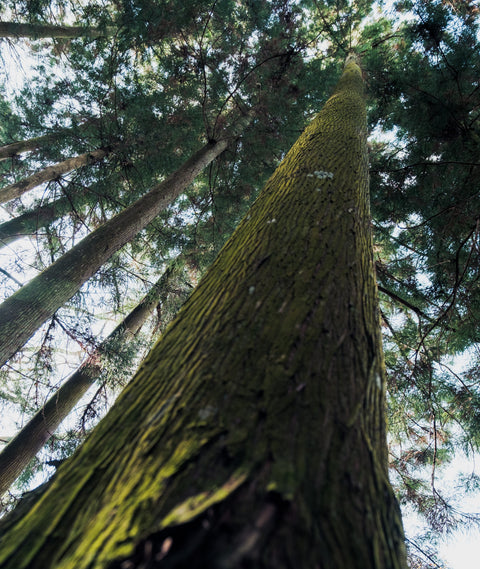
Often referred to as Japanese cedar in English speaking countries, Sugi is a conifer species endemic to Japan. It is by far the most populous tree species in the country, covering 12% of total land area, accounts for 44% of Japan’s artificial forests, and 18% of Japan’s total forest area.
Sugi is the tallest and oldest living tree species in Japan. The tallest trees can grow up to 60m (196ft) tall, and the oldest trees (found in the ancient forests of Yakushima) are over 2000 years old.
Basic Information
| Name | Sugi (杉), or Japanese Cedar |
| Binomial name | Cryptomeria Japonica |
| Type | Conifer (Softwood) |
| Origin | Japan |
| Height | 40-60m |
| Trunk diameter | 2-3m |
Properties of Sugi
Insect and Rot resistant
Japanese cedar is rich in natural oils and tannins, making it highly resistant to water damage, rot and insects. This is why it has been used as a primary architectural material for centuries in Japan, despite the humid climate.
Scent
Sugi has a distinct and refreshingly clear cedar smell. It has cool notes of citrus and sandalwood.
Colour
The heartwood is pale pink to deep reddish brown, often with darker streaks and bands within a wood board. The sapwood is straw-coloured white to pale yellow.
Is Sugi a softwood or hardwood?
Japanese cedar is a conifer, or softwood, which is why it is more lightweight, easier to work, and more uniform in texture and shape than hardwoods.
Note: All conifers are softwoods, and all softwoods are conifers. As the name implies, softwoods are generally softer than hardwoods (broad-leafed trees), although there are notable exceptions such as Balsa, which despite being a hardwood, is one of the softest woods in the world.
Is Japanese Cedar easy to work?
Sugi is exceptionally easy to work with due to its ductile quality, which allows for clean cuts and minimal splintering compared to other softwoods.
This lack of splintering results in cleaner edges and a smooth surface that often appears naturally polished. Additionally, its lower tannin content reduces the risk of bleed-through, making it a great material for various surface finishes.
The History of Sugi
The use of Sugi by Japanese peoples can be traced back to the Jomon period (14,000–300 BCE).
The rapid growth and straight tall trunks of Sugi made it ideal for the huge pillars and beams used in Buddhist temples and Shinto shrines.
One of the most famous applications for Japanese cedar is Yakisugi (焼杉), literally 'Burnt Sugi'. This method involves charring the wood surface to create a natural, rot resistant, fire-resistant, and weatherproof barrier, which is often used for cladding and outdoor surfaces.
Beyond architecture, the aromatic heartwood of Sugi has led to its use in sake barrels, where the wood significantly influences the final flavour of the rice wine.
Its lightweight nature and insulating properties also make it a preferred material for traditional furniture, bento boxes, and modern interior paneling, where its striking red-and-white grain provides a warm, organic atmosphere.
Is Sugi a Cedar?
Sugi (杉) is an evergreen tree belonging to the cypress family Cupressaceae. This genus contains only one species: Cryptomeria Japonica (Sugi).
While it is commonly referred to as "Japanese Cedar" in other countries, this is a botanical misnomer.
True cedars (Cedrus) actually belong to the pine family (Pinaceae). Because cypresses and cedars are entirely different genetic families, Sugi is technically a cypress, not a cedar.
Sugi is not the only victim of this type of botanical misidentification. The Western Red Cedar from the Pacific Northwest also belongs to the Cypress family. Similarly, the Eastern Red Cedar is actually a Juniper, which is another member of the Cypress family.
These naming errors likely arose when Europeans mistakingly categorised overseas Cypresses in Asia and America based on their look, aroma and decay resistance properties. Traits that are very similar to cedars found in Europe.
What does Sugi mean?
The name Sugi (杉) is thought to have derived from the word Massugu (真っ直ぐ), which means straight, as Japanese cedar grows tall and upright. Over time, the sugu in Massugu is said to have evolved into "Sugi".

Featured in


